Retail loss prevention has historically been treated as a technology problem.
Investment has therefore focused on detection systems, tagging formats, and surveillance capability, under the assumption that improved technology would directly correlate with reduced shrink.
While these components remain necessary, they are no longer sufficient to explain the widening performance gap between retail security programmes that succeed and those that fail under operational pressure.
In practice, many programmes do not fail because the technology is inadequate. They fail because execution is inconsistent.
Late deliveries, incorrect specifications, installation misalignment, and fragmented supplier coordination introduce risk at the point of deployment. These risks are often predictable, yet remain embedded within traditional supply models.
Trust is built and maintained by many small actions over time.
This paper examines the growing importance of trust — defined as consistent, reliable execution — as the primary determinant of success in modern retail security programmes.
Scope and Methodology
This paper draws on observed rollout patterns across national retail estates, industry benchmarks, supplier operating models, and practitioner experience.
The analysis focuses on how programmes behave in live retail environments, identifying where execution failure occurs and how it can be mitigated through structural change.
Rather than theoretical modelling, the emphasis is on practical delivery: how systems are specified, how they are supplied, and how they are ultimately deployed in store environments.
Context and Structural Drivers
Retail environments have undergone a structural shift.
Shrink is persistent and increasingly organised. Theft is targeted and commercially motivated, often exploiting known vulnerabilities in store operations.
At the same time, store operations are leaner and less tolerant of disruption, with reduced capacity to absorb delays or rework.
Security technologies have become more standardised, shifting differentiation toward execution rather than product capability.
Execution risk now sits alongside theft risk — and often precedes it. A poorly executed rollout can create exposure before any security measure is fully operational.
Evidence and Data Observations
Common execution issues include late delivery, incorrect consumables, incompatibility, and misaligned installation.
These issues are rarely isolated. They tend to occur in combination, creating compounding operational challenges across stores and regions.
The impact is immediate: unprotected stock, operational disruption, increased cost, and reduced supplier confidence.
Over time, reactive behaviours become embedded, including emergency reordering and workarounds at store level.
These are systemic execution failures embedded within delivery models, rather than one-off operational errors.
Operational Failure Modes
These failure modes follow a predictable delivery sequence:
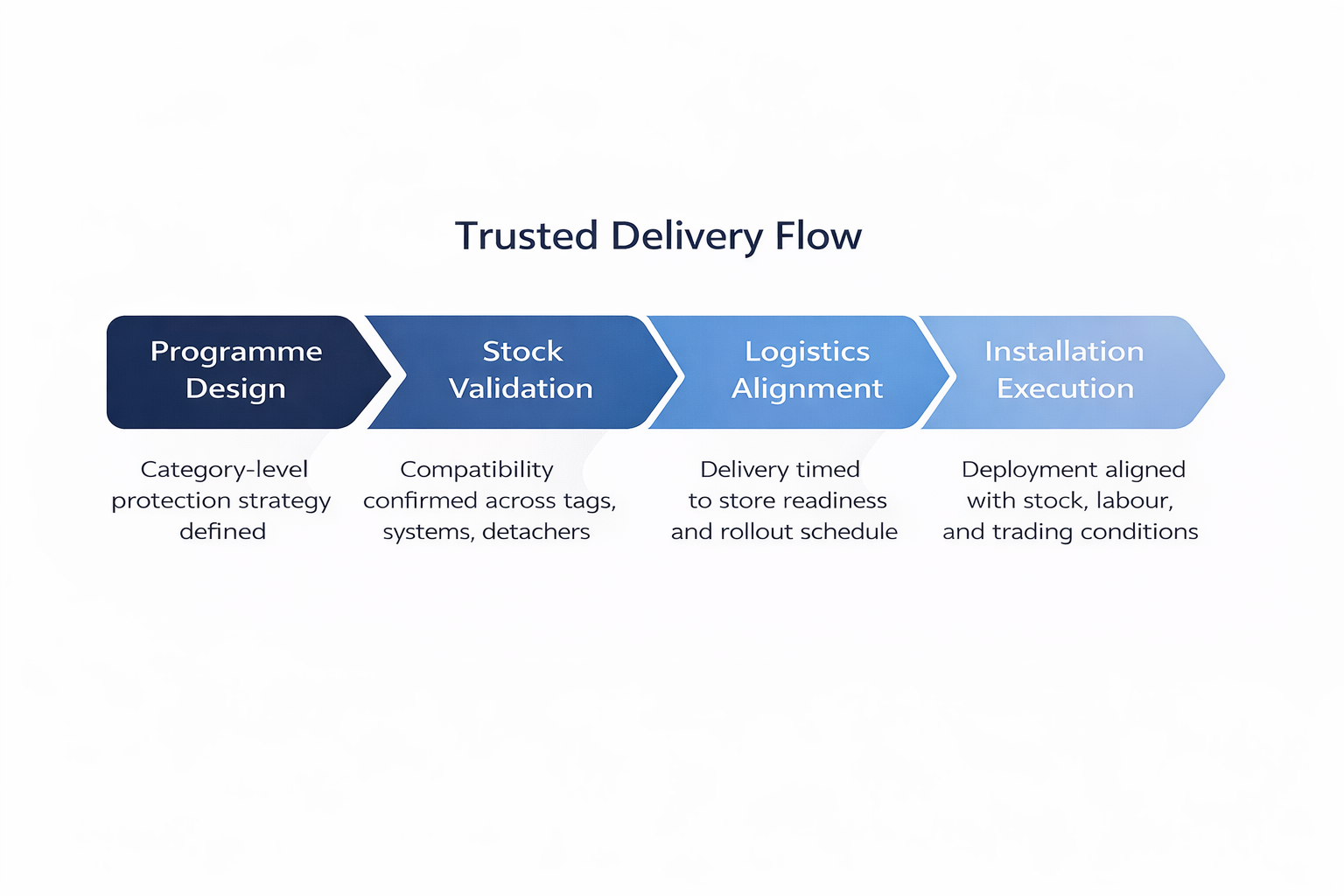
- On-Time Delivery Failure — Protection arrives after the point of need, reducing preventative effectiveness.
- Right-First-Time Failure — Incorrect or incompatible products require rework and delay deployment.
- Disjointed Execution — Logistics, stock, and installation operate without alignment, creating gaps in delivery.
- Commercial Ambiguity — Unclear pricing and reactive charges reduce transparency and trust.
- Scaling Failure — Solutions that work in pilot environments fail to perform consistently at scale.
Targeted and Bespoke Responses
Leading retailers are responding with structured execution frameworks.
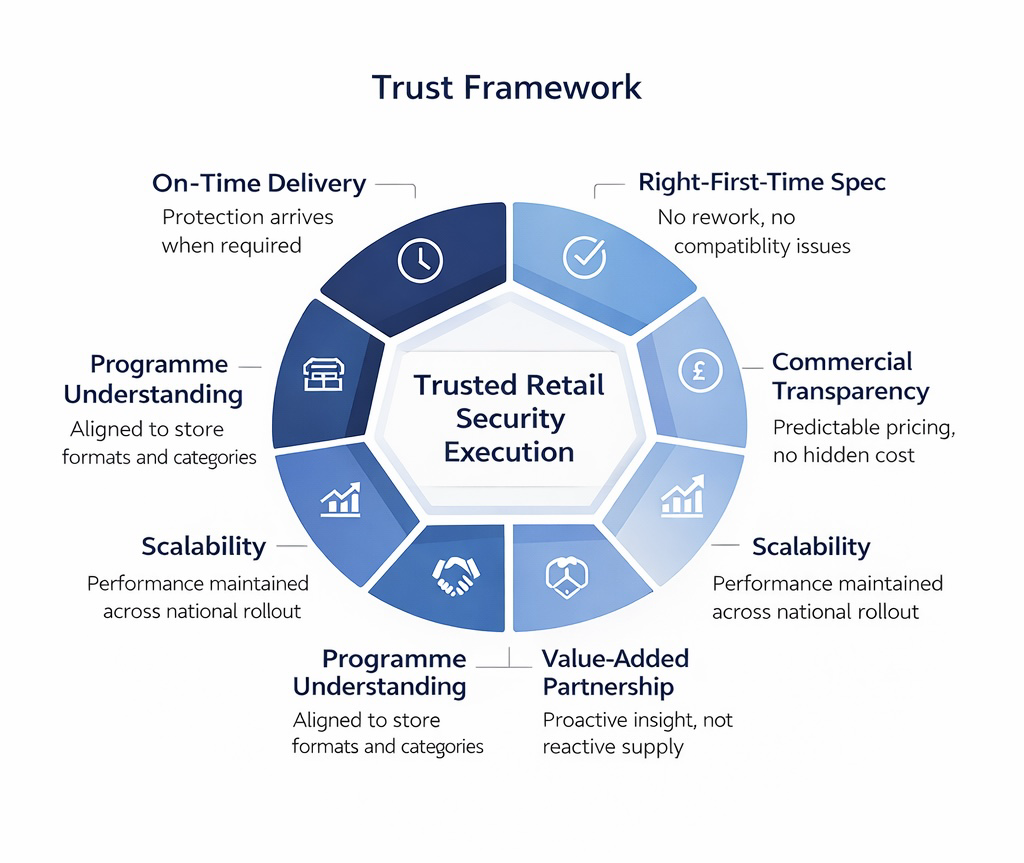
This execution-led design includes validated compatibility across systems, UK-held stock to reduce supply chain risk, and integrated logistics aligned to store readiness.
Programme ownership is becoming more centralised, replacing fragmented supplier models with accountable delivery structures.
Category-specific protection strategies are also emerging, reflecting real theft patterns rather than generic deployment approaches.
This represents a shift from security as a product to security as an operational system.
Implications for Operators and Decision-Makers
Supplier evaluation must prioritise execution reliability alongside cost and product capability.
Trust should be treated as an operational risk factor with measurable impact on shrink, cost, and programme performance.
Loss prevention must be managed at programme level, with clear ownership, governance, and alignment across all delivery stages.
Conclusion
Retail security is no longer defined by technology alone. It is defined by how effectively that technology is delivered, deployed, and maintained within live retail environments.
Execution has become the differentiating factor between programmes that scale successfully and those that fail to deliver consistent outcomes.
Trust, in this context, is not a soft concept. It is an operational capability that underpins programme performance, reduces risk, and drives commercial outcomes. Retailers who recognise and prioritise this shift will be better positioned to protect margin, improve efficiency, and build more resilient loss prevention strategies.